Port Ellen 
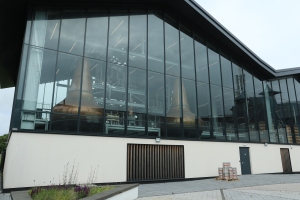 The new Port Ellen distillery is located just outside the town of Port Ellen, next to the Diageo malting factory.
The original distillery was established as a malt mill in 1825 but then developed into a distillery in 1833. The original warehouses
still exist and are listed buildings. The original distillery was acquired by The Distillers Company (DCL) in 1925, was closed in 1930,
and then rebuilt in 1966/1967. It closed again in 1983, some buildings were converted and the stills were destroyed.
Port Ellen's original whisky was used exclusively for blending but since 1998 its remaining stocks are
reserved for single malt bottlings only.
The new Port Ellen distillery is located just outside the town of Port Ellen, next to the Diageo malting factory.
The original distillery was established as a malt mill in 1825 but then developed into a distillery in 1833. The original warehouses
still exist and are listed buildings. The original distillery was acquired by The Distillers Company (DCL) in 1925, was closed in 1930,
and then rebuilt in 1966/1967. It closed again in 1983, some buildings were converted and the stills were destroyed.
Port Ellen's original whisky was used exclusively for blending but since 1998 its remaining stocks are
reserved for single malt bottlings only.
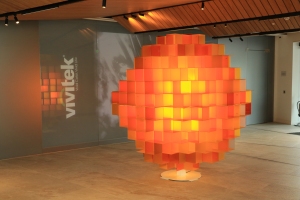 The new Port Ellen distillery is difficult to describe adequately. It is a modern building with thoughtful design and a focus on
sustainability and future proofing. It elicits an air of being uncompromising, determined, diligent, contemporary, experimental. The
reception area is free of furniture but contains a large 'orb' of coloured recycled plastic cubes that's designed to represent
the different expressions of whisky. Upstairs is an elegant lounge area with specially commissioned artwork and
contemporary furniture.
The new Port Ellen distillery is difficult to describe adequately. It is a modern building with thoughtful design and a focus on
sustainability and future proofing. It elicits an air of being uncompromising, determined, diligent, contemporary, experimental. The
reception area is free of furniture but contains a large 'orb' of coloured recycled plastic cubes that's designed to represent
the different expressions of whisky. Upstairs is an elegant lounge area with specially commissioned artwork and
contemporary furniture.
Process heating is using a renewable-biofuel boiler, glazing is self-cleaning (with some success) and coated to reduce solar heating. The building is of a galvanised steel structure that is entirely load-bearing; this means the glass panels are not load-bearing and some can be removed to allow future replacement of stills. There is a deliberate policy of 'radical transparency' so that nothing is hidden; floors are gratings and mundane equipment is visible through large windows. In the roof, there are rows of sound baffles to reduce noise levels both inside and out. Energy and water consumption are minimised to reduce environmental impact.
There is a pair of stills that are precise replicas of those removed in the 1990s so that new spirit is expected to be a close match to that produced at the time the distillery was closed. Another pair of stills, one third the size of the main stills, is used both for main production and also, for four months each year, experimental projects. There is a ten-year plan for experimental projects. The experimental stills are routed through a unique ten-cut spirit safe to ten receivers so that up to 10 separate cuts can be isolated. This allows a more refined new-make spirit to be created by accessing previously unexplored flavours and characters. The distillery is clearly not designed for mass production, in contrast to Caol Ila, rather to emulate the whisky production of the previous Port Ellen and with both pairs of stills operating can produce 1,700,000ℓ/year. There's more information here.
The Tasting
This event is called Port Ellen Reborn and costs £250 but with the promise of trying a 1979 46-year old whisky and a look around the new distillery it's a one-off visit. These events take place about 4 times a month.
The visit was hosted by Tracy Shachtay and Megan O’Mahony, who met us at the pedestrian gate. There was a tour around the distillery including a view into the lab, the milling room, mashing area, washbacks and stills. Photographs are permitted anywhere except within 2m of the stills. Tracy moved from Royal Lochnagar in January 2025 and joined Port Ellen 'as private client and brand home host'.
 The first tasting was in Warehouse 2 and the whisky was a 1979 refill Bourbon cask. I volunteered to draw the whisky using a valinch;
the dram was probably only 15ml but enough to taste. The nose was of orange peel, the palate pear followed by a short finish.
No discernable smoke after this length of maturation.
The first tasting was in Warehouse 2 and the whisky was a 1979 refill Bourbon cask. I volunteered to draw the whisky using a valinch;
the dram was probably only 15ml but enough to taste. The nose was of orange peel, the palate pear followed by a short finish.
No discernable smoke after this length of maturation.
The whisky was coming to the end of its life in two ways: (1) there was very little remaining, (2) it was down to 40.4% ABV so would no longer be whisky when it fell below 40%. Distilleries usually mix low ABV casks with higher ABV casks before the low cask reaches 40%. Strictly, it is not allowed to mix a cask that's already below 40% with anything else and still call it whisky.
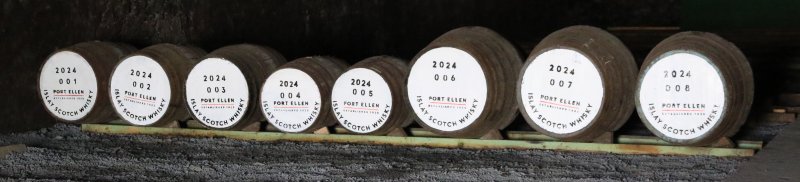
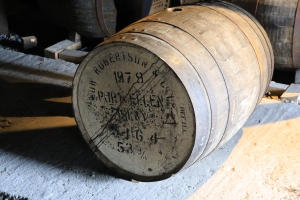 Warehouse 2 is currently being used to store new whisky. It also holds the first eight casks filled by the new distillery in 2024.
The second tasting was in the upstairs lounge and of a 1978 bottling 35 year old (2014 14th edition) at 56.5%. This was matured in European oak and American oak casks with only 2,964 individually numbered bottles produced. Currently priced at £4000-£5000.