
Bunnahabhain 
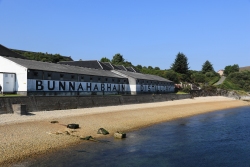
Situated on the northeast coast of Islay, Bunnahabhain was established in 1881 and, unusually, had few changes of owner. It is presently owned by Distell of South Africa, originally a wine company and now owned by Heineken: Distell also owns Tobermory and Deanston. The distillery can be found down four miles of narrow, winding and undulating single track road off the A846 and clings to a rock hollow from which the stone to build it was quarried. Bunnahabhain had been designed from the start as a high-output distillery and after expansion in 1963 has a production capacity of over 3,000,000 litres per year but is producing less than that today. The distillery has the largest mash tun on Islay, holding about 15 tons of barley. The first wash is 50,000 litres of water at 64°C which is drained out over four hours. This is followed by 24,000 litres at 83°C over two hours. The third and fourth washed at 21,000 and 22,000 litres are used as the first wash in the next batch. There are six washbacks that are filled to 65% and give an 82 hour fermentation. The distillery has its own pier but this fell into disuse in the early 1990s and all incoming fuel and malted barley, and outgoing whisky, is by road. Maturation is done on site but bottling is done on the mainland.
The visitor centre and shop has been moved from the quaint but somewhat cramped first-floor office with rumpled carpet and sagging shelves to a new location opposite. It's well stocked and has a range of Bunnahabhain-branded items. The staff are friendly and knowledgable and tours informal. The distillery is undergoing a major re-organisation with old buildings being converted or demolished and rebuilt.
It is only in 1979, recently in whisky terms, that Bunnahabhain has been available as a single malt. Prior to that it was a peated whisky that was destined for blending into Cutty Sark. It is now available in 12- and 18- year old unpeated and a variety of sherry, port, wine and other finishes. Limited edition older releases are made from time to time including a range for The Coterie. Peated varieties are still produced and represent 10% of output. Peated barley used to come from Port Ellen Maltings but with Port Ellen distillery now operational, Diageo may not always have enough to provide a reliable supply. Unpeated barley comes from Simpson's, on the mainland. There are two wash stills and two spirit stills.
Bunnahabhain means 'mouth of the river', and that would be the Margadale River, and shares its name with the hamlet that grew up nearby. There is a continuing expansion planned for the next few years with the demolition of a warehouse to make a new car park, demolition of the old houses to build a new warehouse and conversion of the cottages into a cafe and demolition of the existing visitor centre.
Warehouse 9 Tasting Experience
David hosted the tasting session:
- Cask 3135, 2012 Oloroso 700ℓ butt, 3rd or 4th fill and very little colour
- Cask 2735, 2014 Canasta sherry (cream sherry), 10 year old 60.9%, dark amber, sweet
- Cask 201556, 2019 hogshead 5 year old 60.2% Fino sherry (sherry sweetened with rectified grape must)
- Cask 333, 2005 Manzanilla 20 year old, 49.4% dark amber, slightly salty finish
David ending the tasting with two gaelic songs, accompanied by his guitar. He had played guitar previously on other occasions and on the Mystery Tour bus during Feis Ile 2023.
Purchases